Pomp, Parade and Illuminations: How Americans Decorate for the Fourth of July
FestiFowl Team
Jun 10, 2026
The Fourth of July is the one holiday where the decorating instructions were written by a Founding Father. Here's what he asked for, how the first celebrations actually looked, and how to dress your house (the right way) this summer.
John Adams's to-do list
On July 3, 1776, John Adams wrote to his wife Abigail that the day of independence should be celebrated "with Pomp and Parade, with Shews, Games, Sports, Guns, Bells, Bonfires and Illuminations from one End of this Continent to the other." There's a twist: he was talking about July 2, the day Congress voted for independence. History picked the 4th, the date on the Declaration, but his list stuck.
When Adams wrote "illuminations," he meant candles lit in the windows of houses, the 18th-century version of string lights.
The first Fourth
A year later, on July 4, 1777, Philadelphia threw the first big anniversary celebration. Ships in the harbor were dressed with flags, cannons fired 13-gun salutes for the 13 states, and the evening fireworks began and ended with 13 rockets. Houses across the city put candles in their windows; Adams called it "the most splendid illumination I ever saw."
Why porches use bunting, not draped flags
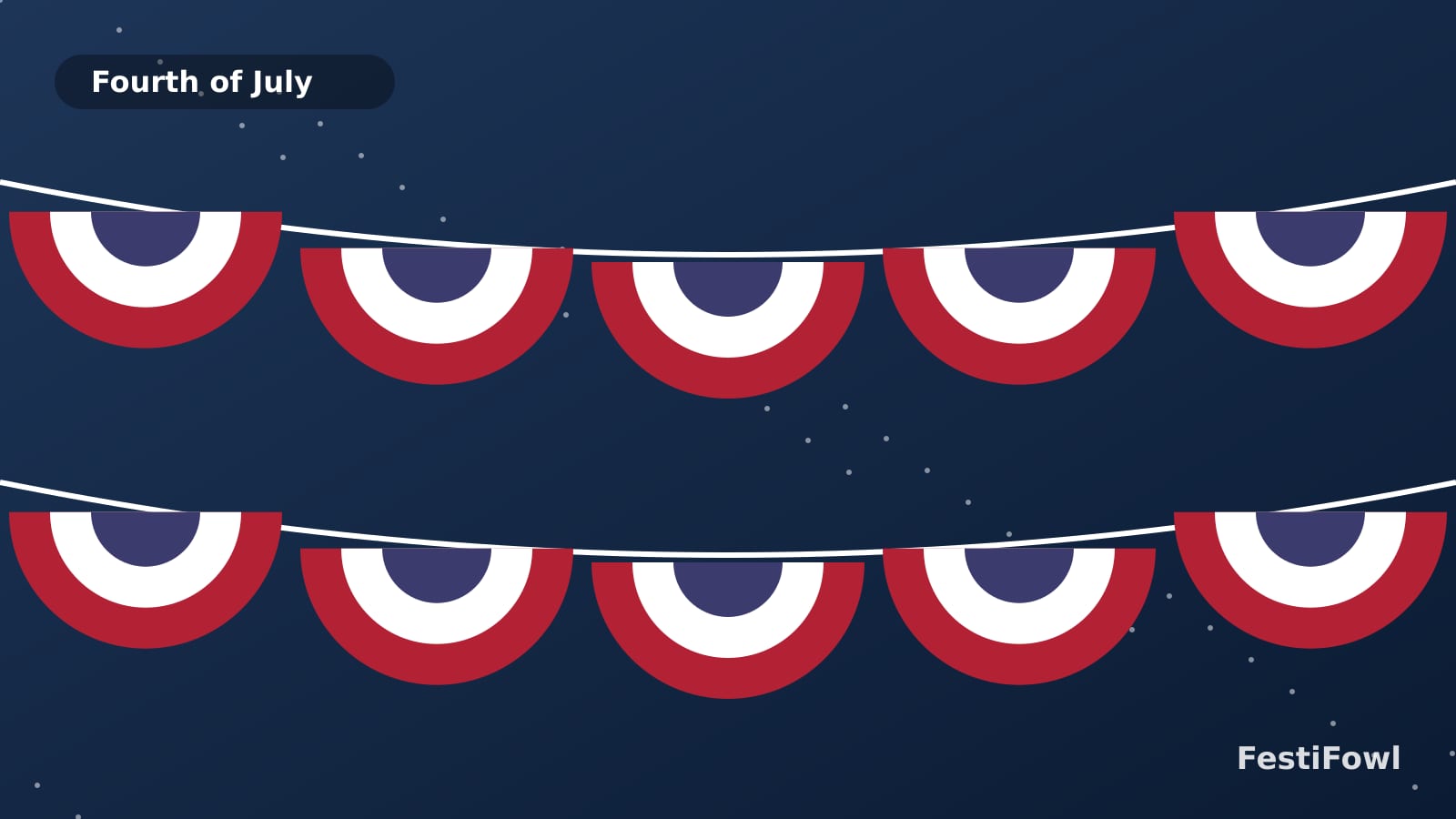
If you've ever wondered why patriotic porches are covered in half-round fans of red, white and blue fabric instead of actual flags, there's a rule behind it. The U.S. Flag Code, first written by a national flag conference in 1923 and made federal law in 1942, says the flag itself should never be used as drapery or festooned. For decoration, it says to use bunting, with blue at the top, white in the middle and red at the bottom.
Red, white and blue bunting became a common sight on American buildings in the second half of the 1800s, especially around the country's centennial in 1876, though its exact history is fuzzy. Today, pleated fan bunting on a porch railing is about as American as it gets.
Ideas for your house
- Hang bunting the right way. Space pleated fans evenly along your porch railing with the blue stripe on top, as the Flag Code suggests.
- Use the porch overhang. A row of bunting or a banner along a covered porch's roofline reads well from the street.
- Recreate the 1777 illumination. Put a flameless candle or lantern in every front window after dark, just like Philadelphia did.
- Count to 13. Line the walk with 13 lanterns or fly a 13-star flag, a nod to the original states and those 13 rockets.
- Tuck flags into what you have. Stick small flags into planters, window boxes, galvanized buckets or your everyday wreath.
- Plant the colors. Red geraniums, white petunias and blue lobelia make a living red-white-and-blue display that lasts all summer.
- String lights for the evening. Warm string lights make a porch feel festive after the fireworks.
- Fly the flag properly. If you fly a flag, keep the blue field at the top of the pole, and light it if it stays up overnight.
National holidays are one of FestiFowl's event types, and there's a Fourth of July contest on the calendar. When your porch is ready, upload a photo and see how it scores.
Sources
- Massachusetts Historical Society, Adams Family Papers: John Adams to Abigail Adams, July 3, 1776
- Harvard University, Declaration Resources Project, "July 1777"
- History.com, "How July 4th fireworks began"
- The American Legion, "The U.S. Flag Code"
- Cornell Law School Legal Information Institute, 4 U.S. Code § 8
- Lowe's, July 4th decorating ideas